The EAC-PM’s new call for rural economic clusters echoes a 5-I model — Identification, Inventorization, Integration, Institutionalization, Investment — proposed for Indian dairy back in 2014
When the Prime Minister stood at the Red Fort this August 15, marking 80 years of independence, he did something planners in Delhi rarely do — he named the disease before naming the cure. Announcing the Saptadhara, the seven streams meant to carry India toward a Viksit Bharat by 2047, he placed agriculture and food processing squarely inside a framework built around manufacturing quality, technology, logistics and self-reliance. It was not a stray mention. Read alongside his repeated public call — most recently at the Grameen Bharat Mahotsav — for India to build “5-6 more cooperatives like Amul” with genuine national reach, and alongside Gujarat’s recent “Amul AI” initiative folding artificial intelligence into the cooperative spine, a pattern becomes visible. The Prime Minister keeps returning to one idea: individual schemes, however well-funded, do not build an economy. Institutions do.
Focus on building rural economic clusters
That is precisely the argument S Mahendra Dev and KK Tripathy of the Economic Advisory Council to the Prime Minister made in these pages recently, in a piece that deserves to be read twice. Their diagnosis, drawn from field visits to Puri and Ganjam in Odisha, is uncomfortably familiar to anyone who has spent time in India’s dairy belt: a farmer gets production support from one agency, feed from another, credit from a bank, insurance from somewhere else entirely, and no one connects the dots. Machinery gets installed, subsidy gets disbursed, a processing unit gets commissioned — and then it limps along at a fraction of capacity because nobody thought about raw material aggregation, branding, logistics or market access in the same room. Their prescription is the rural economic cluster: cooperatives, FPOs and SHGs serving as institutional anchors, with finance, skills, infrastructure and markets built around them, so that local producers actually capture the value they create instead of watching it leak out at every handoff.
I read that piece with genuine appreciation, and also with a quiet sense of recognition, because the diagnosis Dev and Tripathy have laid out — with the weight of the EAC-PM behind it — is one that dairy practitioners on the ground have been arriving at independently for a long time. It took me back to a white paper called Dairy Industry Vision 2030, which I had the privilege of chairing back in February 2014, under the “Dairy Industry Vision” series. We were looking eleven years further out than Dev and Tripathy are today, but from where we stood, we were staring at much the same wall: an industry with enormous animal populations, real government intent, and genuine investment flowing in — yet growth capped by fragmentation rather than by any shortage of ambition or money. It is heartening, more than anything else, to see that same wall now being named so clearly from within the government’s own economic advisory establishment.
The 5-I Model
The framework we proposed then, which we called the 5-I model, was built on a simple conviction: a scheme can support an activity, but only a community, organised at scale, can build an economy. The five steps were Identification, Inventorization, Integration, Institutionalization and Investment — deliberately sequential, because we had seen too many well-meant interventions fail from being run out of order.
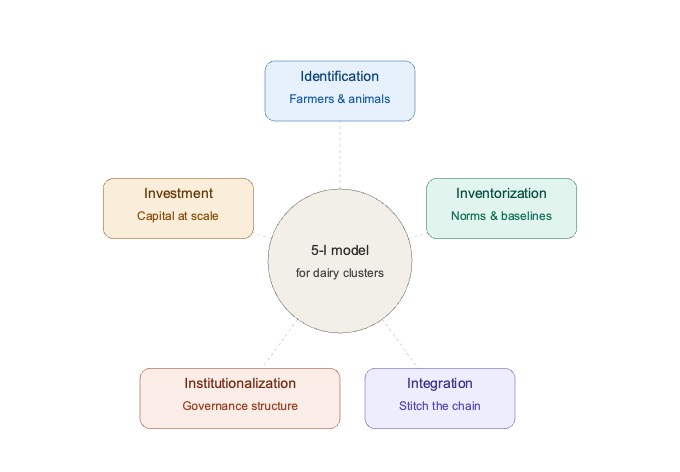
Identification meant something unglamorous but foundational: enrol every farmer, every animal, every actor across the value chain — feed and fodder suppliers, breeding and AI networks, equipment vendors, quality labs, research institutions, cold-chain and logistics players — into a single visible map. You cannot integrate what you have not first counted.
Inventorization took that map and layered it with reality: what standards, skill levels and local practices actually existed at each node, benchmarked against best manufacturing practice, then grouped geographically and demographically into identifiable clusters rather than scattered individual cases. This is, in essence, exactly the exercise Dev and Tripathy are calling for when they ask why a dairy cluster in coastal Odisha isn’t already connecting breeding, feed, veterinary care, processing, cold chain and branding under one roof.
Integration was the step where the value chain actually got stitched together at the cluster or regional level — production linked to processing, processing linked to markets, finance and technology layered across the whole, so that critical mass could emerge instead of a thousand disconnected micro-efforts.
Institutionalization was, and remains, the hardest ask: a governance structure — we argued for dedicated ministerial ownership of dairy development, which India has since moved toward through the Ministry of Cooperation and the architecture around it — with clear accountability rather than the diffuse, overlapping mandates that let good schemes die of neglect between departments.
And Investment came last, deliberately, because we believed capital poured onto an unintegrated system produces exactly the outcome Dev and Tripathy describe from Odisha: assets that exist but enterprises that don’t.
Result Chain Approach
We also proposed, in that same document, a results-chain approach to each of these five steps — mapping activities to outputs, outputs to outcomes, and outcomes to the final impact of sustainable dairy growth, so that every intervention could be tested against whether it actually moved the needle rather than merely spent the budget. It is, in spirit, the same test the CSS ( Centrally sponsored Schemes) restructuring the government has undertaken in recent years was meant to apply — rationalising centrally sponsored schemes precisely because too many of them measured activity instead of impact.
What makes this worth revisiting now, rather than filing away as an old white paper, is that each of the five Is has since acquired a real government address — not as a deliberate response to a 2014 conference paper, but as an independent arrival at the same logic. It is worth naming the pairing, one I at a time, because the fit is close enough to be instructive.
Identification is now Pashu Aadhaar — the INAPH database run by the National Dairy Development Board, which assigns every animal a 12-digit unique ID recording its breed, pedigree, calving and vaccination history. Government figures put the number of animals already carrying that identity at well over 35 crore, and the Rashtriya Gokul Mission’s own doorstep artificial insemination drive alone has covered 8.39 crore animals and reached 5.21 crore farmers to date. This is Identification exactly as we defined it in 2014 — not a census for its own sake, but the precondition for every subsequent step, because nothing about breeding, health or productivity can be managed at scale until the animal and the farmer behind it are on record.
Inventorization has taken shape as the National Dairy Code, developed with the National Dairy Research Institute and now pushed out to states through the Animal Welfare Board of India, laying down minimum standards for breeding, feeding, housing and health of dairy animals. That is close to a literal reading of what we asked for: a documented baseline of practice against which capacity-building and cluster formation could be planned, rather than each district reinventing husbandry norms on its own.
Integration is visible in the revised National Programme for Dairy Development, approved alongside the Rashtriya Gokul Mission specifically to modernise and expand dairy infrastructure so that production, chilling, processing and markets sit on a connected chain rather than as isolated capital assets — the same complaint Dev and Tripathy raise about Odisha’s underused processing units.
Institutionalization is the clearest match of all: the Rashtriya Gokul Mission and the National Livestock Mission, both re-aligned under a single Development Programmes umbrella, with a combined outlay of roughly ₹5,700 crore across the current Finance Commission cycle — ₹3,400 crore for RGM and ₹2,300 crore for NLM — plus the newer institutional architecture of the Ministry of Cooperation standardising PACS bylaws nationwide. This is what we meant by a dedicated governance spine rather than schemes competing for the same farmer’s attention across departments.
Investment, finally, is the Animal Husbandry Infrastructure Development Fund, whose outlay now stands at ₹29,110.25 crore with roughly ₹10,320 crore already sanctioned as loans to dairy and meat processing units, feed plants and breed-multiplication farms. That AHIDF was designed to follow, not precede, the identification and institutional work already under way is precisely the sequencing our results chain insisted on back in 2014.
The numbers underline why the sequence matters. The Basic Animal Husbandry Statistics 2025 record India’s milk production at 247.87 million tonnes for 2024-25, up 3.58 per cent on the previous year, with per capita availability having risen from 319 grams a day in 2014-15 to 485 grams a day now. Milk production overall has grown 63.55 per cent in a decade and productivity by 26.34 per cent — genuine gains. Yet the same data show just five states, Uttar Pradesh, Rajasthan, Madhya Pradesh, Gujarat and Maharashtra, account for over 54 per cent of national output, which is exactly the kind of concentration a cluster strategy is meant to correct by building comparable institutional depth in the districts that are still relying on scattered, individually-run milch animals rather than organised production.
The way forward
I don’t say any of this to claim priority for its own sake. I say it because the gap between 2014 and 2026 is instructive. What has changed is not the diagnosis — it was correct then and it is correct now — but the willingness of the state to act on it. Saptadhara puts agriculture and food processing inside a manufacturing-and-export logic rather than treating it as a welfare afterthought. The push for more Amul-scale cooperatives, the Ministry of Cooperation’s standardisation of PACS bylaws across states, the extension of primary societies into services well beyond milk procurement, and now the early experiments in layering AI onto cooperative data — all of this is, whether consciously or not, an Institutionalization and Integration story catching up with a diagnosis that dairy practitioners have been making for over a decade.
What remains undone is the last mile Dev and Tripathy point to and that our 5-I model insisted must come only after the groundwork: investment that follows integration rather than substituting for it. A processing unit without an aggregation ecosystem behind it is not a cluster; it is a stranded asset with a plaque on the wall. If the Saptadhara is to mean anything for the crores of small and marginal dairy farmers who still supply the bulk of India’s milk, the sequence has to be honoured — identify, take stock, integrate, institutionalise, and only then invest at scale. We wrote that down in 2014. It is genuinely heartening to see the country’s apex economic advisors make the same case today, with the standing to ensure it is actually heard.
Source : Editorial by Kuldeep Sharma Chief editor Dairynews7x7.com
Download India Dairy vision 2030 here
Article by S Mahendra Dev and KK Tripathy