India, the world’s largest milk producer (700 million LPD), has built a powerful dairy ecosystem through institutions like Department of Animal Husbandry and Dairying (DAHD) and National Dairy Development Board (NDDB) . Over 130 million LPD of milk is processed by cooperatives , private sector and new age Farmer producer’s organisation like Amul, KMF, Mother Dairy, Hatsun, Nestle Payas, Mahi, etc . Traditionally, our focus has been on core products—milk, curd, paneer, butter, and ghee. Fresh dairy products like liquid milk, curd, buttermilk, Paneer and ghee constitute nearly 70-75% of total processing in organised sector.
However, alongside this massive production, we generate significant volumes of dairy by-products such as whey, buttermilk, skimmed milk, and ghee residue. Historically, many of these streams have been underutilized or treated as low-value outputs, often limited to animal feed or local consumption.
Today, that narrative is rapidly changing.
Globally, whey has evolved into a multi-billion-dollar ingredient in sports nutrition and functional foods. Buttermilk is being rediscovered as a probiotic and sustainable beverage. Skimmed milk is a base for high-protein and low-fat innovations, while even ghee residue—once overlooked—is finding applications in traditional foods and nutraceutical exploration.
For India, this shift is not just about innovation—it’s about:
- Maximizing farmer income
- Improving processing efficiency
- Reducing waste and enhancing sustainability
- Positioning Indian dairy on the global value-added map
I am sincerely thankful to Anuga Foodtech India for organising such a timely and impactful session on “Innovative Dairy By-Products: Unlocking Value Beyond Milk” and for giving me the opportunity to moderate this important discussion.
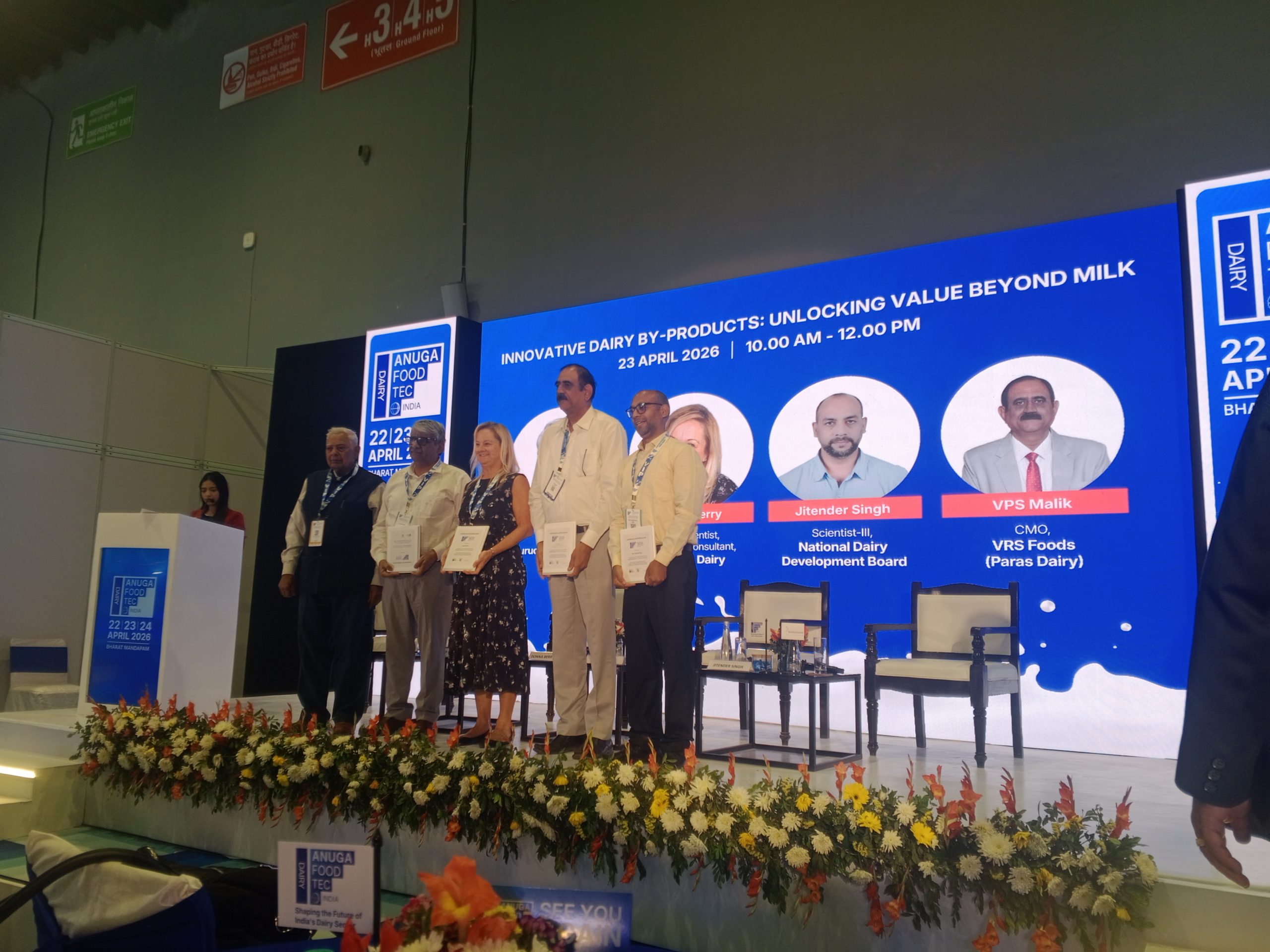
It was truly enriching to engage with an exceptional panel comprising Donna Berry (USA), known globally for her work through Daily Dose of Dairy and Berry on Dairy; Mr. VPS Malik, CMO at Paras (VRS Foods); and Dr. Jitender Singh from NDDB, bringing deep expertise in product and process development. Their diverse perspectives made the session both insightful and forward-looking.
Challenges and key takeaways
How do we shift our mindset from treating these as by-products to unlocking them as true value drivers in the dairy economy—and what global and domestic (Indian) innovations are leading this transformation into high-value applications?
Some of the key takeaways from the discussion were particularly compelling:
- It is becoming increasingly clear that making dairy economically viable for farmers will not be possible without a strong shift towards value-added products.
- Dairy by-products, especially whey, offer one of the most promising avenues for unlocking this value.
- Globally, companies are not only focusing on nutrition but also on taste—leveraging advanced ingredients and flavor technologies to mask off-notes in whey-based products and improve consumer acceptance.
- Consumer behavior is rapidly shifting towards protein-rich diets; however, there is a need for regulatory support to ensure transparency through parameters like PDCAAS and clear type of protein source labeling.
- Whey is also opening up opportunities beyond food, including innovative applications such as bio-ethanol production.
- From an Indian perspective, the whey generated from the organized paneer and cheese sector alone is expected to exceed imported WPC 80 volumes (~20,000 MT), potentially saving nearly USD 250 million in foreign exchange—without even accounting for the unorganized sector.
- There is a strong need for policy support to build infrastructure for whey collection and processing—similar to milk cooperatives—and for initiatives like AHIDF to support whey drying plants at the district level. Such interventions can also enable the use of whey protein in programs like mid-day meals, contributing to national nutrition goals.
A particularly powerful closing thought from the session was that, in the future, value addition in whey could become so significant that whey may be seen as the primary product, with cheese becoming the by-product. Even today, the high value of WPC 80 is enabling processors to subsidize cheese pricing in the HoReCa segment.
Once again, thank you for curating such a meaningful dialogue and for the opportunity to be part of it. I look forward to many more such engagements that help shape the future of the dairy sector.
Source : Event report by Kuldeep Sharma Chief Editor Dairynews7x7. April 24th 2026