Achieving ‘Green Revolution-plus’ through horticulture alongside productivity boosts in our staples is key to the ‘Viksit Bharat’ strategy
India, with an agriculture output of over 1,300 million tonnes (MT) in 2023-24, is food secure. However, nutritional deficiency, low farmer incomes and ecological unsustainability continue to remain our bane. The country’s historically pluralistic platter of agri produce is challenged by an agricultural management that prefers specialisation over diversification. Crop diversification involves practising a range of agricultural/ cropping systems to meet society’s demands, aligned with the location’s agro-ecology and national priorities. In 2018, the Committee on Doubling Farmers’ Income (DFI) submitted its report to the government, which recommended that they adopt high-value agriculture (HVA), including horticulture, animal husbandry and fisheries. In 2015-16, horticulture, with just 7 per cent of the net cultivated area, contributed 25 per cent to the agricultural GVA (gross value added).
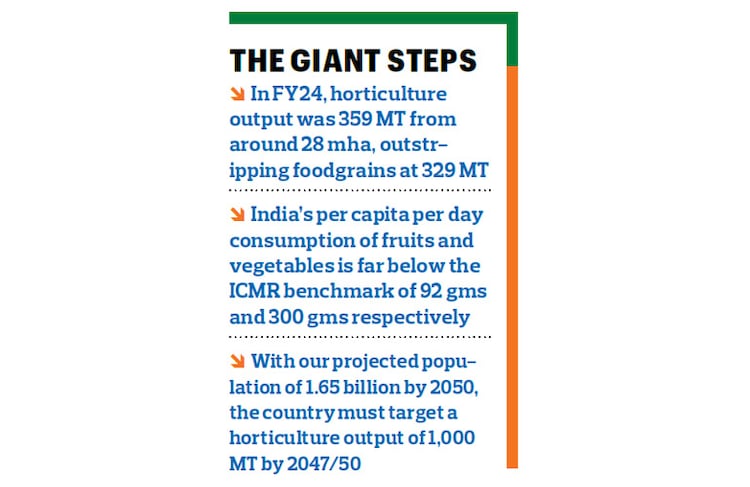
India’s ‘Viksit Bharat’ strategy requires a regular emphasis on agriculture. The Green Revolution provided basic food security, ‘Harvesting Horticulture’ can now target nutritional and income security, leading to a Green Revolution-plus or GR-plus. This strategy offers essential micronutrients, engages more manpower on the farms and processing factories, enhances agricultural household purchasing power, stimulates the rural economy, and aids climate change mitigation. Horticulture, which encompasses fruits, vegetables, flowers, plantations, spices and medicinal plants, has been a key diversification domain since the 1980s. In 2023-24, horticulture output was 359 MT from around 28 million hectares, exceeding the foodgrains output of 329 MT. Research shows that small and marginal farmers benefit more from diversification into fruits and vegetables, particularly the latter. A National Sample Survey Office (NSSO) survey revealed that additional income due to an area shift to horticulture was as high as Rs 69,129 per ha. in 2012-13. This shows that diversification towards horticulture can result in higher incomes for farmers.
Potential in horticulture:
Horticultural crops genetically have more potential than the agronomic, and can yield over 30 tonnes per hectare. Current productivity averages are low, indicating growth potential through genetic improvement and better cultivation practices. Among these:
- Water usage: Fruits, vegetables, flowers and some spices are high water-demand crops. Practices like micro-irrigation boost productivity (25-50 per cent) and save water
- Food loss and waste: Minimising food losses (4.5-15.9 per cent) through strengthened agriculture logistics and processing is crucial. This will also help in transferring greater income to the farmers
- Market access and trade: Efficient marketing and transparent price discovery mechanisms are needed. Enhancing agri-logistics and cold storage infrastructure is vital
- Agri-processing: Right now it is low (12 per cent in the organised sector), particularly in fruits and vegetables (2.5 per cent). Upgrading capabilities is essential for market integration
Other challenges/ thrust areas:
The capital to output ratio in horticulture is relatively high, but the output per unit of land and its monetised value are higher too. Supply-side constraints must be addressed to respond to demand growth. Some focus areas are:
- Address structural challenges via FPOs (farmer producer organisations), etc. to improve operational efficiency of small farms
- Risk management through contract farming, real-time advisories and crop insurance
- Maximise production through orchard rejuvenation, rational crop geometry, besides promoting alternative technologies like hydroponics and aeroponics
- Digital technologies for precision farming, certified seed production and nursery banks
- Alternative marketing channels, export facilitation and intervention schemes akin to MSP
- Job generation and supplementary incomes through processing and other activities like beekeeping and mushroom farming