Probe Looms Longer: China Extends EU Dairy Investigation

In a strategic escalation of trade defences, China’s Ministry of Commerce has extended its anti-subsidy investigation into European Union dairy imports—covering milk, cream, and cheese—by six months, now slated to conclude on February 21, 2026, citing the complexity of the case . This is not an isolated development. It follows earlier investigations into EU pork…
GDT Event 386 declined by 0.3% & Global Dairy Trends
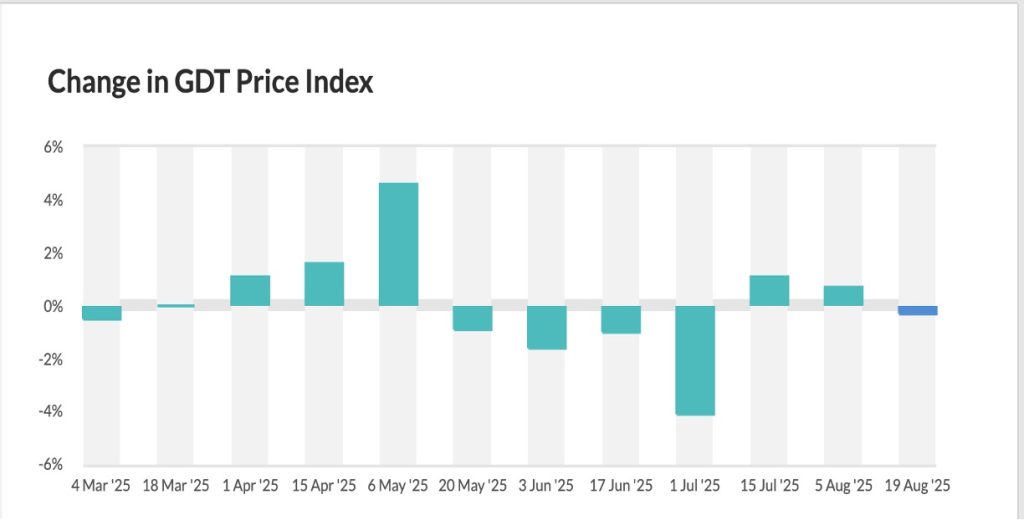
On Tuesday, 19 August 2025, GDT Trading Event 386 recorded a 0.3% decline in the overall GDT Price Index. The average price landed at US $4,291 per metric tonne (equivalent to €3,676). Among key product movements: Anhydrous Milk Fat (AMF) edged up 0.1% to $7,078/MT. Butter declined 1.0%, now at $7,144/MT. Cheddar decreased 0.5% to…
India & NZ: Opposite Forces Steering Global Dairy

The global dairy market is not only about commodities — it is a geopolitical chessboard in constant motion, where beyond cows, milk and cheese, economic power, food security and policies come into play, capable of shaking entire nations. In this arena, India and New Zealand represent polar opposites: the former, a colossal producer that consumes…
Australia Drives Dairy Exports to Southeast Asia
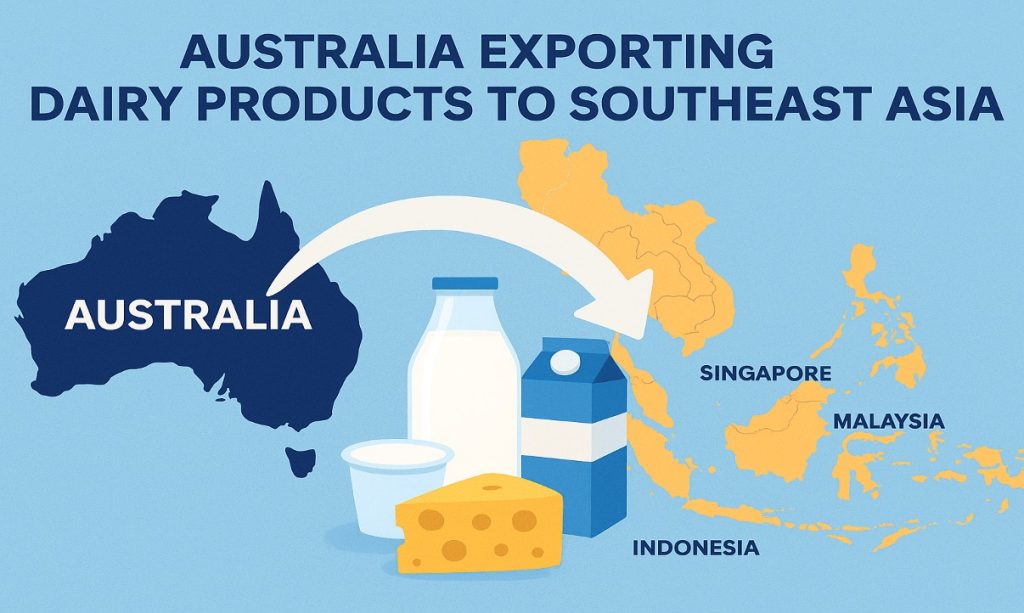
Australia’s dairy sector, in collaboration with Austrade (the Australian Trade and Investment Commission), is intensifying its focus on Southeast Asia—a region now accounting for approximately 87% of its dairy exports. In the fiscal year 2023–24, Southeast Asia imported over 290,000 tonnes of Australian dairy, valued at more than A$1.2 billion, with Singapore, Indonesia, and Malaysia…
China Extends Dairy Probe Amid EU Trade Tensions

China has extended its anti-subsidy investigation into European Union (EU) dairy products—including milk, cream, and cheese—by six months, pushing the deadline to February 2026. The Ministry of Commerce in Beijing cited the “complex nature” of the case as the reason for the extension. This investigation is widely seen as part of a broader tit-for-tat trade…
Global Milk Surge Pressures Dairy Market Stability

A sharp increase in milk production across the European Union, United States, and New Zealand is exerting significant downward pressure on commodity dairy prices. With supply now outpacing demand—amid weakening domestic consumption and slow export growth—market fundamentals are shifting toward bearish sentiment. The EU faces easing supply constraints but afternoon droughts threaten feed stocks. In…
Milk Not Essential for Strong Bones- Harvard study

Contrary to long-standing dairy marketing, milk consumption is not definitively vital for building stronger bones, according to nutrition experts at Harvard’s T.H. Chan School of Public Health. As reported by Jay Lau on August 14, the notion that milk’s calcium content directly translates to fewer fractures is unsupported by long-term studies. While both dairy products…
ILO–AFTECH to digitise credit for Indonesia’s dairy

Indonesia’s dairy sector, which currently supplies under 25% of national demand, is set for a financing boost through a new partnership between the International Labour Organization (ILO) and the Indonesia Fintech Association (AFTECH). Signed in Semarang on August 12, 2025, the collaboration pilots a digital-credit model in East Java that integrates enterprise resource planning (ERP)…
Fermentation & automation steer emerging dairy trends

A new industry scan flags where near-term dairy trade will grow: precision fermentation, automated milking, and data-led farm tools. Precision/cellular platforms are moving from pilot to purchase orders, with the broader cellular agriculture market projected to reach USD 786.74B by 2033 (16.12% CAGR)—and fresh capital still flowing (e.g., Perfect Day’s USD 90M pre-Series E). Cheese…
UK dairy shaken by worker crisis—food security at risk

A sweeping labour shortage in the UK’s dairy sector is raising alarms over national food security. Arla Foods, the country’s largest dairy cooperative, reports that 84% of dairy farmers now struggle to attract qualified applicants, up from 79% in 2021. Of those surveyed, nearly half (48.6%) find staff retention harder than before the pandemic, while…