
-
Arbitrage: MPC’s protein‑density advantage and New Zealand’s freight advantage into Asia will continue to shape product mix and regional premiums.
-
Fundamentals: High milk supplies versus patchy demand argue for volatility rather than a straight‑line rally.
The best opportunities lie in logistics‑aware arbitrage. Buyers should choose origin, product and destination with freight, working capital and demand risk front of mind, rather than chasing headline theoretical returns alone.
Powders Firming, Fats Mixed
Global benchmark prices have stabilised after February’s sharp rally, with the latest mid‑March GDT auction essentially flat overall (+0.1% index), masking divergence within the complex.
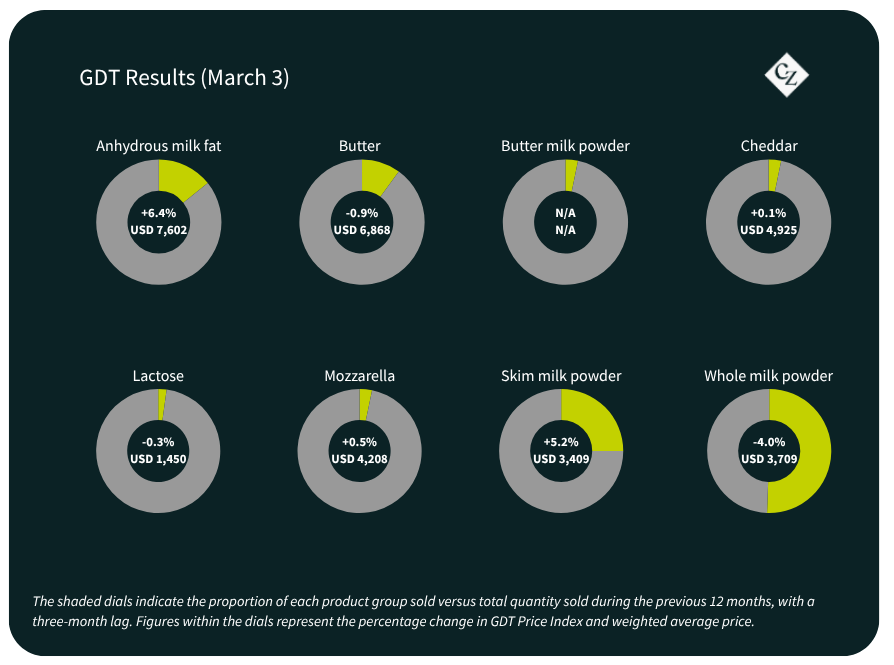
Skim milk powder (SMP) rose 5.2% to about USD 3,400/tonne, while whole milk powder (WMP) fell 4% to around USD 3,700/tonne, reinforcing the recent shift in value from fat‑heavy to protein‑heavy streams. Anhydrous milk fat (AMF) gained 6.4% to roughly USD 7,600/tonne, while butter eased slightly.
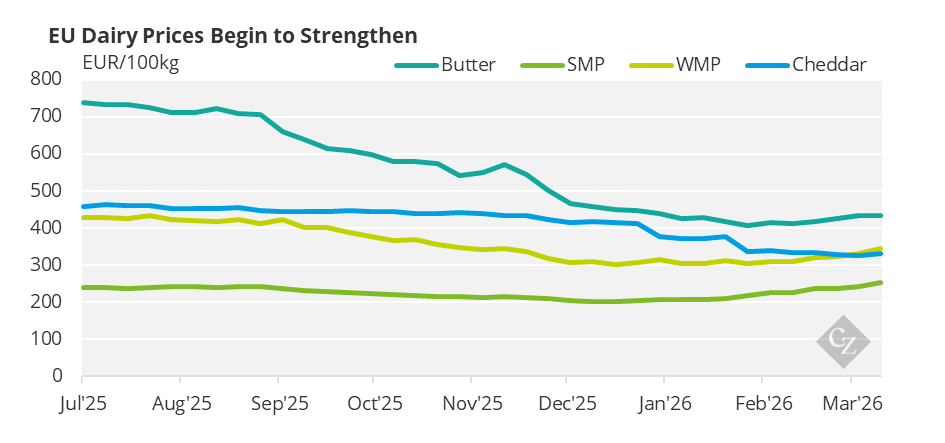
EU market data show a similar pattern. SMP was up 4.6% week on week in the week ending March 15 to around EUR 2,530/tonne. WMP was up 3.7% to near EUR 3,500/tonne and butter stayed relatively flat at about EUR 4,340/tonne, underlining a still‑compressed fat premium versus historical norms.
Source: European Commission
In the UK, wholesale indicators suggest “green shoots” in powders and cheese as speculative buyers return, despite high milk supplies and product stocks. Overall, the last two weeks have consolidated February’s price reset rather than extended it, but the internal price structure of stronger protein, softer fat continues to evolve.
Trade Flows and Regional Differentials
Indian SMP into the Gulf: Reports of allegedly cheap Indian‑origin SMP moving into Gulf markets fit with India’s growing role as a price‑aggressive exporter when domestic stocks are comfortable. India is increasingly present in powder export flows, especially into price‑sensitive destinations. This undercuts Oceania and EU SMP in parts of the Middle East, widening regional differentials.
Gulf demand risk: At the same time, the Gulf faces income pressure from the broader regional crisis and shipping disruptions. Lower earnings for informal workers (for example, taxi drivers doing fewer trips) translate into weaker demand for value‑added dairy and foodservice channels, even as basic staples remain resilient. That combination of cheaper Indian SMP plus softer discretionary demand tilts the Gulf towards low‑cost ingredients and away from premium fat‑rich products.
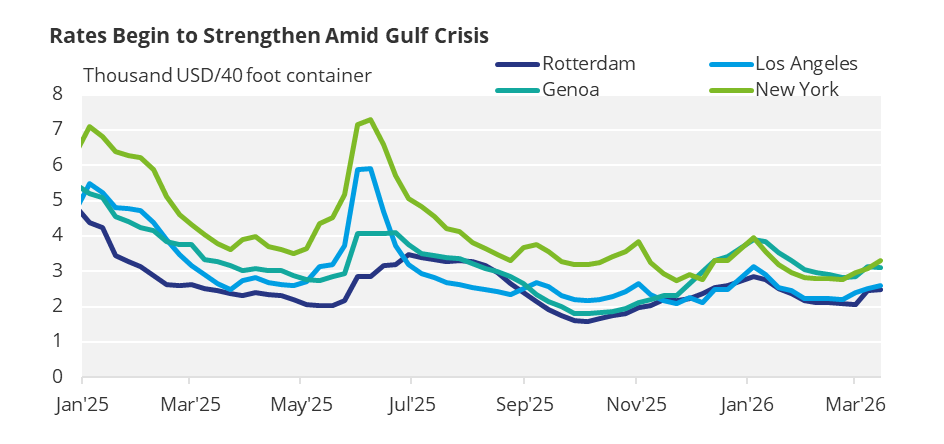
Freight‑driven geography: Red Sea and wider Middle East shipping risks have structurally raised freight rates and extended transit times, with many carriers routing via the Cape of Good Hope. This disproportionately disadvantages EU product into Southeast Asia versus New Zealand, despite EU’s nominal price advantage on paper. As a result, Southeast Asian buyers are willing to pay a premium for NZ-origin powders to secure shorter, more reliable transit and lower logistics risk.
Source: Drewry
In short, EU powders should be the cheapest on a FOB basis, but heavily penalised into Southeast Asia by freight. New Zealand powders are mid‑priced FOB but best landed into Asia. Indian SMP is cheapest into the Gulf and AMF is carrying a strong premium into Middle East destinations but with elevated route risk.
SMP+AMF Versus WMP, MPC Versus SMP
SMP + AMF stream: On current GDT prices, the theoretical SMP+AMF stream return looks attractive relative to WMP. However, NZ processors are likely to keep prioritising WMP.
SMP is the most commoditised and hotly contested product globally, while AMF demand is heavily concentrated in the Middle East—precisely the region facing freight and demand uncertainty. WMP, by contrast, has a broader market base and can be placed more reliably across Asia and Africa.
In a risk‑heavy freight environment, processors may prefer slightly lower, but more certain WMP returns and faster cash conversion over higher‑value SMP+AMF that ties up working capital and market risk.
MPC versus SMP protein arbitrage: The protein relativity premium for milk protein concentrates (MPCs) over SMP is widening. With 1 tonne of MPC70 containing roughly the same protein as 2.06 tonnes of SMP, logistics become a key driver. One container of MPC moves more protein per slot than SMP, reducing freight and warehousing cost per unit of protein.
In a world of elevated freight risk and buyers wanting larger buffer stocks, MPC offers a compelling arbitrage for protein users—especially where functional requirements allow substitution away from SMP. This is likely to keep MPC prices relatively firm versus SMP and could cap SMP’s upside in some applications.
Supply, Demand and Macro Fundamentals
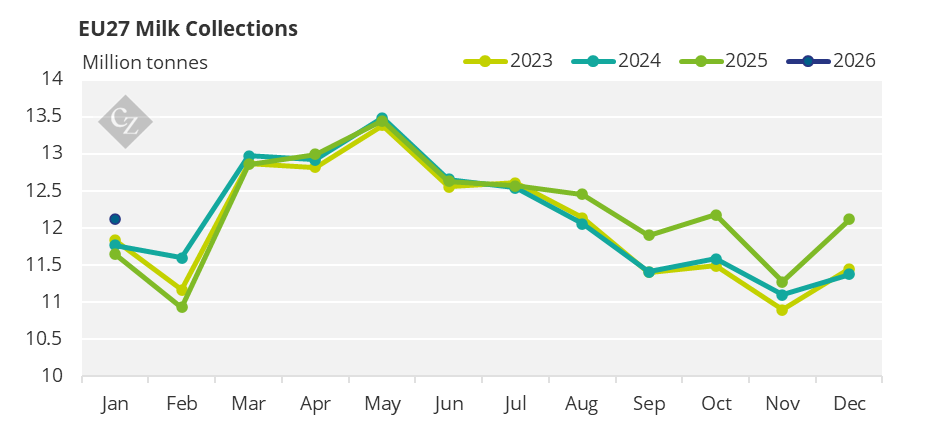
On the supply side, milk production remains robust in several key regions. GB deliveries in February were up 3.7% year‑on‑year and 5.3% higher for the season to date, a record level that keeps pressure on processing capacity.
EU milk deliveries also continue to grow, supported by previously high farmgate prices and good forage conditions. This abundant raw milk underpins ample availability of powders and fats, even as some product stocks begin to tighten at the margin.
Source: Dairynews7x7 28th March, 2026 From Our Partner Channel